|

|
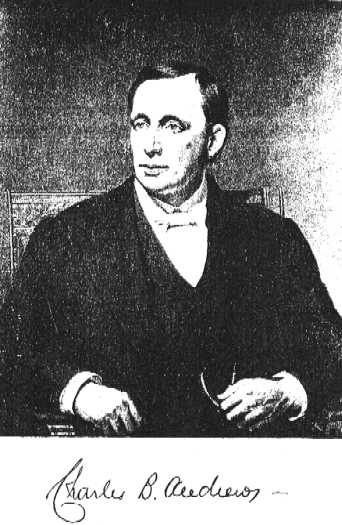
Charles Bartlett Andrews
From: The Governers of Connecticut
By: Frederick Calvin Norton
Published: 1905
CHARLES Bartlett Andrews, the former chief justice of the Connecticut Supreme Court, was a descendant of Wil liam
Andrews, one of the first settlers of Hartford, and for a long period its town clerk. His father was Rev. Erastus
Andrews, pastor of a church in North Sunderland, Massachusetts, he having removed to that state with his family
early in life.
Judge Andrews was born in Sunderland, November 4, 1834, and entered Amherst College in 1854, where he was graduated
with high honors four years later. He then studied law in the town of Sherman, Connecticut, and in 1680 was admitted
to the Fairfield County bar, beginning practice in the small town of Kent. His progress was rapid and he soon became
known as one of the ablest young men of the section. When John M. Hubbard of Litchfield was chosen a member of
Congress in 1863, he secured Andrews to take charge of his large law practice while the former was attending the
sessions in Washington. Hubbard was at that time the leader of the Litchfield County bar, and his selection of
so young a man to look after his business was a great compliment to the legal ability of Andrews.
Becoming a partner of Hubbard, he conducted the practice of the firm with much success during the succeeding four
years, and handled some of the most important cases that came before the bar of the county. Andrews soon grew to
be one of the leading lawyers of that section and naturally became prominent in politics. He was elected a member
of the State Senate in 1868 and re-elected in 1869.
Andrews came into prominence during the second session, when he occupied the position of chairman of the Judiciary
Committee. In the early seventies several of the old-time lawyers of the Litchfield bar, who enjoyed large practices,
were removed from the field of action from one cause or another. Hubbard died; Origin S. Seymour and Edward W.
Seymour, two other able lawyers, removed to Bridgeport; so that Andrews at the age of forty, found himself in
possession of the largest and best practice in that portion of the state. During the next few years his time was
wholly absorbed in attending to the duties of his profession, and he did not enter into politics. In 1878, however,
he accepted the nomination for representative from Litchfield. At the following election Andrèws was elected
and enjoyed the distinction of being the first Republican to hold that office since the Civil Waf. In this session
Andrews was chairman of the Judiciary Committee and leader of the House, where he made a strong impression as an
able, earnest, painstaking legislator. It has been said by a writer that
the wisdom as a leader displayed by Andrews at this session was what led to his nomination for governor later on.
In 1878 Andrews was nominated for governor of the state, and as the state government had been in the hands of the
Democrats for almost a decade, his chances were thought to be very slight. In the election lie received a plurality,
but was elected by the Legislature. in commenting on Governor Andrews administration, the Medico-Legal Magazine
says: During Governor Andrews two years term of office, several important measures were before the Legislature.
The boundary line between Connecticut and New York, which had remained uncertain for a century and a half, in fact,
since the foundation of their governments, was at last settled by a joint commission, whose report was accepted
by the legislatures of both states. But by far the most important legislation of Governor Andrews term was the
passage of the Connecticut Practice Act a measure framed by some of the most eminent lawyers in the state to serve
the purpose of the codes framed in other states for simplifying and reforming the common law pleadings and practice
in civil actions. Having the benefit of thirty years experience elsewhere, this act was a model of simplicity
and practical usefulness, reforming what was cumbersome and intricate in the old practice, while it retained the
advantage of the sound principles and innumerable precedents underlying it.
Its success has fully justified the expectations of those who procured its passage, and it formed a most important
epoch in the history of Connecticut legislation. Returning to his practice, Governor Andrews was appointed a judge
of the Superior Court in i88i by Governor Bigelow. His ability on the bench was demonstrated to such a degree that
in 1889, on the retirement of Chief Justice Park, Governor Bulkeley appointed Judge Andrews to that position. Succeeding
Chief Justice Park in the chief judicial office of the state, Governor Andrews occupied the position during a period
when some of the most important cases in the history of the state were before the court. The celebrated quo warranto
suit growing out of the deadlock of 1891, the legal contest growing out of the legislation regarding the East Hartford
bridge affitir, and the suit of the state against the Aetna Insurance Company, were some of the most important
matters before the court. He was untiring in his work, had a wide range of vision which broadened with experience,
possessed much sagacity, was uncommonly well versed in the law and had the gift of Yankee common sense developed
to a noticeable degree. It is said that many of the more important decisions of the Supreme Court, while Judge
Andrews was on the bench, were written by him, and although occasionally some of his learned colleagues differed
from his opinion, they all recognized in him ability of a high order, great power of analysis, and conceded his
thorough knowledge of law and the principles of its application. Judge Andrews tendered his resignation as chief
justice to Governor McLean on June io, 1901, to go into effect October 1st. It was reluctantly accepted by the
governor. The General Assembly at the next session appointed Judge Andrews a state referee from December 1, 1901.
The ex-governor then retired to his home in Litchfield where lie lived in partial retirement. In November, 1901,
Governor Andrews was unanimously chosen the delegate from Litchfield to the late Constitutional Convention at Hartford,
held in 1902. He was made presiding officer of the convention by practically unanimous agreement, as was Governor
Oliver Wolcott of Litchfield eighty years before. He attended the session very faithfully and spoke occasionally
on the floor of the convention.
Governor Andrews wide accomplishments were recognized by the leading universities, as he was made Doctor of Laws
by Yale, Amherst and Wesleyan universities.
He died very suddenly at his home on South street in Litchfield on September 12, 1902. The funeral services were
held on Monday, September 15th, in the Episcopal Church at Litchfield, many state officers being present.
Of Governor Andrews career the best estimate was written by Charles Hopkins Clark in the Hartford Courant as
follows:
Judge Andrews has often and fitly been cited as a fine illustration for the younger men of what chances there
are for those who have the sense and ability to improve their opportunities. He started as a poor and unknown boy
and he reached our highest and most honored offices by doing as well as he could what came upon him to be done,
and by avoiding nothing that did come. When others declined the empty nomination for governor, he accepted, ready
alike for defeat or victory; and, when he was elected, he filled the office so well that other things naturally
followed. He proved equal to whatever came and so honors kept coming.
"His name has become a part of the history of the state and he has had no small part in guiding its development
and shaping its laws. Just running over the places he has held suggests what a large figure he has cut in our affairs.
but one cannot know the whole who has not followed closely the details of his useful work during his long life."
|
|