|

|
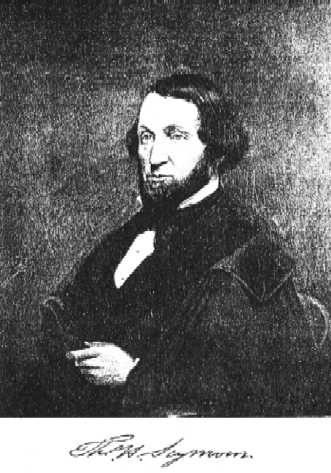
THOMAS Hart Seymour
From: The Governers of Connecticut
By: Frederick Calvin Norton
Published: 1905
THOMAS Hart Seymour was descended from a celebrated English family who settled in that country as early as the
thirteenth century. He was born in Hartford, September 29, 1807, and when very young displayed those traits which
made him a leader of men afterwards. His early education was obtained in the public schools of Hartford, and as
he showed a predilection for a military life he was sent to Captain Alden Partridges institute in Middletown.
He pursued the course at this military school and was graduated in 1829. Returning to Hartford, Seymour was chosen
as the commanding officer of the Light Guard of the city. He then studied law and was admitted to the bar in 1833,
but before he gained much of a practice his love for politics changed his course in life. Becoming editor of The
Jeffersonian, a leading democratic organ, he threw himself into the political discussion of the clay. Seymour
possessed a very attractive manner and a pleasing address, so that he was one of the most popular men of his time.
He was elected judge. of probate of the district, and soon occupied a position in the front ranks of the Hartford
democracy, as their acknowledged leader.
In 1843 Seymour was elected a member of Congress, and when his term had expired he refused a renomination. He was
commissioned in March, 1846, major of the Ninth or New England regiment of volunteers which took part in the Mexican
war. Going to the front with his regiment, he served with such distinction that on October 13th, 1847, Major Seymour
attained high military honors. The capture of Melino opened the way to Chapultepec, the Gibraltar of Mexico, which
was the key to the City oi Mexico. As it was built on a rock iço feet high, impregnable on the north and
well-nigh so on the eastern and most of the southern face, only the western and a portion of the southern sides
could be scaled. The commanders decided, after a council of war, that it must be taken.
Two picked American detachments, one from the west and one from the south, pushed up the rugged steeps in face
of an awful fire. The walls at the base of the castle fbrtress had to be mounted by means of ladders. One of these
detachments was commanded by Colonel Ransom, but as that officer fell early in the assault, Major Seymour led the
troops, scaled the heights, and with his command was the first to enter the fortress. The enemy was driven back
into the city, and Seymour was placed in command of the regiment. He afterwards took part in the capture of the
City of Mexico, and was present when it was fully in the hands of General Scott. When the war was over Seymour
returned to Hartford and received the nomination for governor in 1849, but although there were Democratic gains
over the preceding year he was not elected. The following year, however, he was elected governor of Connecticut
by a large majority. Governor Seymour was re-elected in the years 1851, 1852 and 1853, serving with distinction.
He also served as a presidential elector in 1852.
In April, 1853, President Pierce appointed Governor Seymour United States minister to Russia, and he immediately
resigned his position as governor.
He represented this country at the Russian court for four years, and during his residence there Governor Seymour
formed a warm and lasting friendship for both the Czar Nicholas and his son.
From them he received many costly tributes of their regard for him. After retiring from the position in 1857, Governor
Seymour spent a year in traveling on the continent, returning to the United States in 1858.
Governor Seymour was bred as a Democrat and always upheld the principles of the party with true Jeffersonian tenacity.
During the dark days of 1860 and 1861 he clung to the policy of the Democratic party. When the Southern states
withdrew from the Union, and the Civil War was precipitated, Governor Seymours sympathies were with the South.
He was opposed to the prosecution of the war until its close, and became leader of the Connecticut Peace Democracy.
On account of his pronounced opposition to the Union cause, the Senate of this state, in 1862, voted that the
portrait of Governor Seymour, with that of Isaac Toucey, should be removed from the chamber till the comptroller
should be satisfied of his loyalty to the Federal government. These portraits were taken to a place of safe keeping,
and it is said that only one man in the city of Hartford knew where they were secreted.
In the Democratic party, however, Governor Seymour retained his old-time popularity and in 1863 he was again nominated
for governor. Those were not the days for Democratic successes in Connecticut, and the contest which followed has
probably not been equalled in this state.
After a most exciting canvass Seymour was defeated by William A. Buckingham of Norwich. At the Democratic National
Convention, which met in Chicago on August 29, 1864, Governor Seymour received thirty-eight votes on the first
ballot for president of the United States. He passed the remaining years of his life at Hartford, where he died
on September 3, 1868.
|
|